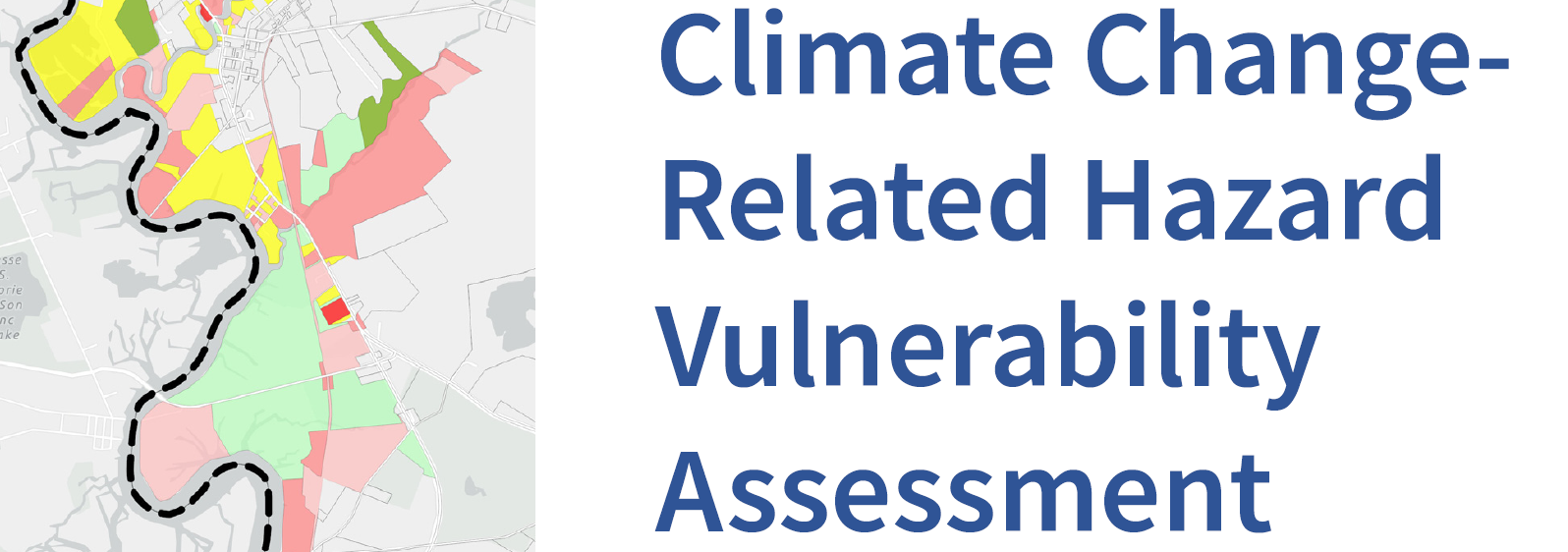
Rutgers collaborated with eight New Jersey municipalities over approximately 18 months to develop Climate Change-Related Hazard Vulnerability Assessments (CCRHVAs) in alignment with the NJ Municipal Land Use Law (MLUL). The MLUL was amended in 2021 to require a CCRHVA as part of the land use plan element of a municipal Master Plan. A CCRHVA must analyze:
- Local climate hazards;
- Vulnerability of local assets, infrastructure, and populations;
- Impacts to Master Plan elements and other local plans; and
- Potential strategies to reduce risk.
Locally tailored data and stakeholder input was gathered by Rutgers’ interdisciplinary team of researchers, GIS analysts, community engagement specialists, and graduate students from Bloustein’s Center for Urban Policy Research – Environmental Analysis and Communications Group and Alan M. Voorhees Transportation Center – Placemaking, Outreach and Engagement Team, as well as the New Jersey Climate Change Resource Center. Each report assesses community exposure to heat, storms (extreme precipitation and wind), drought, flooding, and wildfire, as well as vulnerability of developable land, facilities and infrastructure, land uses, community assets, housing, and people. The CCRHVAs are intended to help municipalities identify land use and zoning approaches to increase resilience to climate change impacts.
This work was supported by the New Jersey Department of Environmental Protection’s Resilient NJ Municipal Assistance Program. In addition to providing free technical assistance to municipalities, the project helped establish statewide planning guidance with quality CCRHVA examples and documentation of effective practices.
Little Egg Harbor Township, Ocean County
Maurice River Township, Cumberland County
Pennsville Township, Salem County